
Portfolio
Lanet Customer Support Service
Customer Support Service is a large-scale internal operations platform built by DigitalTouch for Lanet, unifying subscriber support, CRM, billing, network operations, field service, communications and analytics.
Overview
Customer Support Service is a large-scale internal operations platform created by DigitalTouch for Lanet, one of Ukraine’s major internet and cable television providers. Developed from the ground up between 2010 and 2016, the system brought customer support, subscriber management, billing, network operations, field service and communications into one working environment.
More than 300 employees used the platform to support hundreds of thousands of subscriber accounts. The software handled intensive daily flows of service requests, messages, payments and infrastructure events while integrating with the provider’s wider technical and business ecosystem.
The application is internal and cannot be accessed publicly. It continued to be used after the original six-year development period.
From fragmented tools to one operational platform
Before Customer Support Service, important processes were spread across several legacy applications and manual workflows. Customer information, support history, network context, payment status and operational actions did not naturally meet in one interface.
For an ISP, that fragmentation creates delays. An operator may need to identify a subscriber, review services and debt, determine whether a network incident is already known, create a support request, communicate next steps and coordinate technical work — often during a single conversation.
DigitalTouch replaced this fragmented experience with a shared operational platform. Instead of building an isolated CRM, the team created a system that connected customer-facing work with the technical reality of delivering internet and television services.
A complete subscriber and service workspace
Customer Support Service maintained the operational picture around each subscriber. Employees could work with customer records, contracts, tariffs, active services, payments, debt, contact history, equipment and technical identifiers such as IP and MAC addresses.
The platform covered the core service lifecycle:
- registering and connecting new customers;
- managing subscriber profiles and contracts;
- reviewing tariffs and active services;
- working with billing, payments and outstanding balances;
- creating and tracking support requests;
- coordinating installations and field visits;
- managing incidents and customer communications;
- producing documents and operational reports.
Bringing these functions together gave operators context at the moment it was needed and reduced repeated switching between unrelated systems.
Support connected directly to network operations
Internet support cannot be effective when customer conversations are separated from infrastructure data. The platform connected subscriber requests with network monitoring, equipment records and mass incidents.
This allowed the support workflow to distinguish an individual customer problem from a broader outage. Incident information could trigger operational actions and customer communication, while network context helped employees avoid unnecessary diagnostics or duplicate requests.
The system also supported network equipment management, monitoring data, subscriber devices and the operational relationships between infrastructure and customer services. This placed Customer Support Service between conventional CRM and the OSS/BSS responsibilities of a telecom provider.
Tickets, field teams and operational scheduling
Some issues can be resolved during the first conversation; others require technical investigation or an on-site visit. Customer Support Service connected support requests with dispatching and field operations.
The platform handled technician visits, work scheduling and routing, helping turn a customer request into an accountable operational process. Dispatchers could coordinate workloads while operators retained visibility into what would happen next.
Equipment and warehouse-related information formed part of the same environment. This reduced the distance between customer support, technical work and the physical resources required to complete a connection or repair.
A purpose-built call-center workspace
The system was used by call-center operators, technical support teams and dispatchers. DigitalTouch developed operational tools around the reality of high-volume customer communication rather than treating telephony as an external afterthought.
The platform included web telephony, operator scripts, automatic answers, call-related workflows and scheduling for support staff. Screen recording and monitoring capabilities supported quality control and the analysis of operator work.
Web telephony was one of the project’s most technically demanding areas. Realtime call state, browser behavior, customer identification and CRM context had to remain synchronized while operators worked continuously throughout the day.
Customer self-service through messaging
Telegram and Facebook Messenger bots extended the same service logic beyond the call center. Customers could identify themselves, review account information, check balance and tariff details, make payments, create requests, receive incident information and move to an operator when human assistance was required.
These were not detached promotional bots. They were connected to customer and operational workflows, allowing messenger interactions to become part of the service history rather than a separate communication silo.
Self-service reduced the need to call for routine questions and helped relieve pressure on telephone support. At the same time, escalation paths preserved access to an employee for cases that could not be resolved automatically.
Automation, triggers and workload forecasting
At the scale of hundreds of thousands of subscriber accounts, many repetitive actions cannot depend on manual attention. Customer Support Service used triggers, background processing and automation rules to respond to events across customer, billing, support and network workflows.
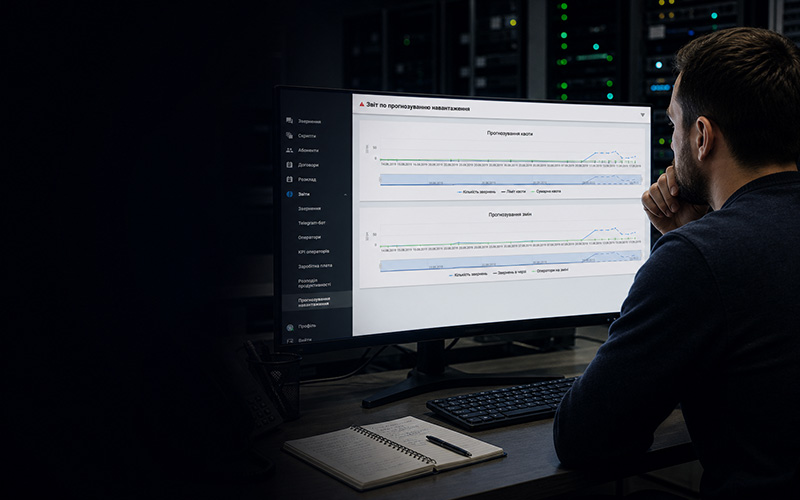
The system supported automatic responses and operator scripts, helping standardize recurring interactions while keeping the relevant customer context visible. Forecasting functionality assisted with anticipating operational load and planning staff schedules.
Forecasting, trigger orchestration and high-volume data processing were among the most complex parts of the project. They required the platform to interpret activity across multiple systems and turn it into timely operational behavior.
Reporting and management visibility
Operational data was translated into dashboards, reports and analytical views for different levels of the organization. Managers could examine workloads, service activity and team performance without relying on disconnected manual reports.
Because the system captured activity across support channels and workflows, it provided a much more complete picture than a standalone ticketing tool. Reporting could draw on subscriber interactions, incidents, operator work and other operational events recorded within the platform.
The project improved internal KPIs and reduced call-center pressure, although exact figures remain confidential and are intentionally not published.
Architecture built to evolve
Customer Support Service began as a modular application and evolved alongside Lanet’s operational requirements. Its architecture combined a modular monolith with supporting microservices, allowing core business workflows to remain cohesive while specialized and realtime responsibilities could be separated where useful.
Laravel and PHP formed the central application layer, backed by MySQL. Redis supported high-speed state and background workloads, while Node.js and Socket.IO handled realtime communication. Nunjucks, jQuery, HTML, CSS and JavaScript powered dense operational interfaces designed for employees who used the system throughout the working day.
The platform exposed APIs to other internal systems and used webhooks, background jobs, queues and realtime events extensively. It integrated both modern components and legacy services that had to remain operational throughout the transformation.
Infrastructure, delivery and observability
The solution ran on Lanet’s own servers. Apache and Nginx formed part of the web infrastructure, with mirrors and load balancing supporting availability. Separate development, staging and production environments allowed changes to be tested before reaching daily operations.
GitLab CI automated delivery workflows, PHPUnit supported backend testing and Zabbix provided infrastructure and service monitoring. The team maintained the platform as a long-lived operational product rather than handing over a one-time software release.
Security for sensitive operational data
The platform combined subscriber personal data, payment context, infrastructure information and detailed records of employee actions. Security therefore had to operate at several levels.
Customer Support Service included granular roles and permissions, two-factor authentication, network and VPN restrictions, encryption, audit logs, backup procedures and data masking. This allowed different teams to access the information required for their work without exposing the entire operational environment to every user.
Detailed action logging also supported accountability in complex workflows involving accounts, payments, services and internal decisions.
Six years of end-to-end product development
DigitalTouch was responsible for the entire delivery lifecycle. A multidisciplinary team of more than ten specialists covered product analysis, architecture, UX/UI, backend and frontend development, QA, DevOps, integrations and ongoing evolution.
The system was not an adaptation of an existing commercial CRM. It was designed and built from scratch around Lanet’s processes, infrastructure and scale. Over six years, the team continuously expanded the platform while maintaining compatibility with existing operational services and supporting employees already dependent on it.
DigitalTouch’s work included:
- product and system architecture;
- UX/UI for high-density internal workflows;
- subscriber CRM and service management;
- billing, payment and debt-related workflows;
- support tickets and incident management;
- dispatching, field work and scheduling;
- network, device, warehouse and equipment modules;
- web telephony and call-center tooling;
- customer-facing messenger bots;
- APIs and integrations with internal and external systems;
- reporting, forecasting and workflow automation;
- security, infrastructure, QA and continuous delivery.
Long-term operational impact
Customer Support Service consolidated several legacy applications and manual processes into one operating environment. It reduced duplicated work, accelerated service and incident handling, improved internal performance indicators and moved routine interactions away from telephone support toward automated and self-service channels.
More importantly, it gave Lanet a platform that could evolve with the provider rather than forcing operations into the limitations of generic software. Its continued use after the primary development period reflects the durability of the architecture and the depth of its integration into everyday work.
Lanet’s current public website is linked only for company context. Customer Support Service remains an internal system and has no public login or demonstration environment.
The challenge
Lanet needed to replace fragmented legacy tools and manual workflows with a single operational environment capable of serving 300+ employees and supporting hundreds of thousands of subscriber accounts. The platform had to connect customer service, technical operations, billing, network data, field teams, communications and management reporting while remaining responsive under heavy daily workloads.
What DigitalTouch built
DigitalTouch designed and developed Customer Support Service from the ground up over six years. The platform combined subscriber and contract management, CRM, tariffs, billing, payments, support tickets, incident handling, field service, network and equipment data, call-center tooling, web telephony, customer messaging, bots, analytics, forecasting, automation rules and administration in one secure operating system for the ISP.
Technical approach
The system evolved as a modular Laravel/PHP and MySQL application supported by Node.js services, Redis and Socket.IO for realtime workloads. Nunjucks and jQuery powered the operational frontend. It ran on Lanet’s own infrastructure behind Apache, Nginx, mirrors and load balancing, with GitLab CI, PHPUnit, Zabbix and separate development, staging and production environments.
DigitalTouch’s role
End-to-end product strategy, architecture, UX/UI, engineering, QA, DevOps and long-term development
Technologies
- PHP
- Laravel
- Node.js
- MySQL
- Redis
- Nunjucks
- jQuery
- Socket.IO
- Apache
- Nginx
- GitLab CI
- PHPUnit
- Zabbix
- Telegram Bot API
- Facebook Messenger
Outcome
Customer Support Service consolidated multiple legacy applications and manual processes, improved operational KPIs, reduced pressure on telephone support and accelerated everyday customer-service and incident workflows. Exact internal performance figures remain confidential. The platform continued to be used after the original development period.