
Portfolio
Synevo
Historical web work for Synevo, translating the scale and complexity of a major medical laboratory network into a clear, trustworthy and responsive digital experience.
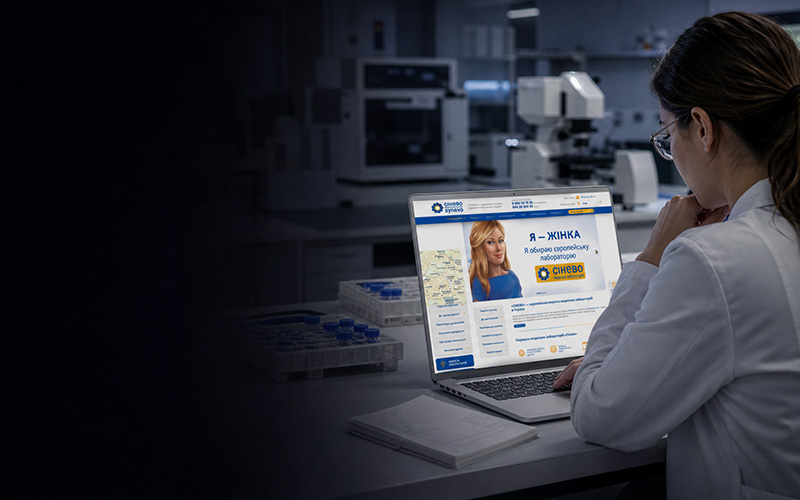
Overview
Synevo is a major European medical laboratory brand with a broad network of collection points and an extensive catalogue of diagnostic tests. Its website serves people at a practical and often sensitive moment: they need to understand what to do, where to go and how to prepare without navigating unnecessary complexity.
DigitalTouch contributed to Synevo’s historical public-facing digital presence. The engagement focused on the experience surrounding the laboratory’s services — presenting complex information through a clear branded interface that could work reliably across devices.
Turning a large laboratory catalogue into clear journeys
Medical diagnostics produces an unusually demanding information architecture. A single website may need to accommodate individual tests, packages, preparation instructions, prices, collection locations, company information and content for doctors or business partners.
Most visitors, however, do not think in terms of the laboratory’s internal catalogue. They arrive with a specific need: find an analysis, check how to prepare, locate a branch or understand how to receive results.
The interface therefore had to guide people from intent to action through recognizable pathways:
- discovering or searching for a laboratory test;
- understanding what the service includes;
- reviewing preparation requirements;
- finding a suitable collection point;
- learning how results and support are accessed;
- moving to the relevant service channel with confidence.
The value of the experience comes from making these steps feel connected rather than forcing users to assemble the process from disconnected pages.
Designing for trust in a medical context
Healthcare interfaces must communicate authority without becoming cold or intimidating. Visitors may be researching routine preventive testing, managing an ongoing condition or responding to a doctor’s recommendation. The design needs to remain calm, legible and predictable in every case.
Clear typography, consistent page structures and disciplined visual hierarchy help users distinguish essential preparation instructions from supporting information and promotional content. Strong brand consistency adds reassurance, while straightforward navigation reduces the risk of misunderstanding the next step.
In this context, usability is part of trust. A page that is easy to scan and an action that behaves as expected contribute directly to the user’s confidence in the service.
Supporting several audiences without fragmenting the experience
Although patients form the largest visible audience, a laboratory network also communicates with doctors, corporate customers, partners and potential employees. Each group needs different information and different routes through the site.
The challenge is to preserve one coherent Synevo experience while allowing specialist sections to have their own depth. Reusable interface patterns and clear top-level segmentation make it possible to expand content without turning the website into a collection of unrelated microsites.
Location is part of the product
For a physical laboratory network, the digital journey is incomplete until the user can connect an online choice with a real collection point. Location information is therefore not secondary corporate content; it is one of the service’s central conversion paths.
A useful branch journey must help visitors understand where a collection point is, whether it is convenient and what they should know before arriving. On mobile devices this becomes particularly important, because people may be making the decision while travelling or immediately before a visit.
Responsive front-end delivery
DigitalTouch’s confirmed technical contribution is the historical front-end implementation. HTML, CSS and JavaScript formed the core presentation layer, with Bootstrap supporting responsive layout patterns and jQuery supporting the interactive behavior recorded for the project.
The implementation needed to maintain readable content, usable navigation and visible actions across desktop, tablet and mobile screens. For a service used by a very broad population, responsive behavior is a fundamental accessibility and usability requirement rather than a visual extra.
Reusable components also help maintain consistency across a large website. Test information, service explanations, location content and company pages can evolve while retaining a recognizable interaction model.
Communicating medical information responsibly
A laboratory website should make medical services understandable without replacing professional interpretation or turning descriptions into unsupported promises. Good content design provides enough context for a person to choose the appropriate next step while maintaining clear boundaries around diagnosis and clinical advice.
This principle shaped the broader digital challenge: simplify navigation and explanation, not the medicine itself. The experience needed to make complex information approachable while respecting its clinical importance.
DigitalTouch’s confirmed role
The historical portfolio record confirms DigitalTouch’s contribution to Synevo’s public digital presence and identifies the front-end technologies used in the engagement.
It does not confirm that DigitalTouch developed Synevo’s laboratory information systems, test-processing infrastructure, personal customer account, online results platform or every capability visible today. Those areas are intentionally not claimed. This case focuses on the verified contribution: delivering a branded, responsive front-end experience for a complex medical laboratory service.
Synevo today
Synevo Ukraine’s current website supports a wide range of journeys, including selecting tests, finding collection points, reviewing customer information and accessing results. It also serves doctors and business customers. These current capabilities demonstrate the scale of the digital service environment, but may differ significantly from the historical version involving DigitalTouch.
Visit the current Synevo Ukraine website
The challenge
A laboratory website must help people find the right test, understand preparation requirements, locate a convenient collection point and access service information without adding anxiety or confusion. At the same time, it must support medical credibility, a large content catalogue and several distinct audiences.
What DigitalTouch built
DigitalTouch contributed to Synevo’s historical public-facing digital presence, with front-end delivery focused on clear service presentation, branded page structures and responsive interaction. The available project record does not establish ownership of Synevo’s laboratory systems, personal account, online results or the current version of the website.
Technical approach
The confirmed front-end stack combined semantic HTML, CSS and JavaScript with Bootstrap and jQuery. It supported responsive templates and reusable interface patterns appropriate for a content-rich medical laboratory website. No unsupported back-end or clinical infrastructure technologies are attributed to DigitalTouch.
DigitalTouch’s role
Historical front-end and digital presence delivery for Synevo
Technologies
- HTML
- CSS
- JavaScript
- jQuery
- Bootstrap
Outcome
The engagement supported a coherent public digital experience for a recognized laboratory brand, making complex medical service information easier to navigate across devices. No unverified business, traffic or clinical performance metrics are claimed.